What Causes Slab Leaks?
Understanding the factors behind slab leaks in Fort Worth helps explain why some homes are more susceptible — and what you can watch for as your plumbing system ages.
Slab leaks don't happen randomly. They result from a combination of factors — some related to the pipe material and installation, some to the environment around the pipes, and some to time. In Fort Worth, several of these factors converge in ways that make under-slab pipe failures more common than in many other regions.
1. Soil Movement — The Primary Fort Worth Factor
The Blackland Prairie clay soil that underlies much of Fort Worth and Tarrant County is what geologists call expansive clay. It swells significantly when it absorbs water and contracts sharply when it dries out. This seasonal and weather-driven cycle of expansion and contraction creates ongoing mechanical stress on everything embedded in or sitting on that soil — including the concrete slab foundation and the pipes running beneath it.
When the soil beneath one part of the slab expands while another part contracts, the slab flexes slightly. Over many cycles, the pipes beneath the slab — particularly at joints, bends, and areas where the pipe runs through a transition zone in the soil — experience repeated mechanical stress that eventually causes the pipe wall or fitting to crack.
2. Pipe Age and Material
Copper supply lines have a service life roughly estimated at 50–70 years under normal conditions — though the soil movement common in Fort Worth can accelerate degradation. Many Fort Worth neighborhoods — Northside, East Fort Worth, South Fort Worth — have homes built in the 1950s through 1980s with original copper supply lines that are reaching or past this range.
Galvanized steel pipe, used in even older homes, corrodes from the inside over time. As the interior corrodes, pipe walls thin and eventually fail.
3. Hot-Water Line Thermal Cycling
Hot-water supply lines fail more frequently than cold-water lines in slab leak situations. The reason is thermal cycling: each time the water heater fires and hot water runs through the pipe, the copper expands slightly. When the line cools, it contracts. Over years and decades, this repeated expansion and contraction creates fatigue at fixed points — particularly at bends, fittings, and anywhere the pipe contacts concrete directly.
This is why warm floor spots are such a reliable indicator — hot-line leaks are the most common under-slab failure type.
4. Water Chemistry (Corrosion from Inside)
The chemical composition of water affects how quickly it corrodes copper pipe from the interior. Water that is acidic (low pH), has high dissolved oxygen content, or contains elevated chloramine concentrations can accelerate copper corrosion — thinning pipe walls faster than expected for the pipe's age.
Municipal water supply chemistry in Fort Worth is adjusted for public health and infrastructure standards, but older distribution systems and the interaction of water with aging copper pipe still create localized corrosion conditions.
5. Construction and Installation Factors
Slab leaks sometimes result from how the pipe was installed rather than from long-term degradation:
- Pipes that were kinked or damaged during installation develop stress points that fail earlier than a straight run
- Pipes that contact concrete directly without protective wrapping experience abrasion from slab movement
- Improper fitting installation or inadequate support at transition points creates early failure locations
- Electrolytic corrosion where dissimilar metals contact each other without proper isolation
6. Previous Slab Movement
Homes that have already undergone foundation repair — pier and beam adjustment, piering, etc. — may have experienced pipe stress during the foundation movement process. A pressure test after foundation repair work confirms whether any under-slab plumbing was affected by the structural adjustments.
Neighborhoods with older housing stock (built 1950s–80s) on Blackland Prairie clay soils tend to have higher rates of slab leak incidents — simply because the combination of aging copper and expansive soil is most concentrated there. This includes parts of Northside, East Fort Worth, South Fort Worth, and older areas near Downtown. Newer construction using PEX supply lines is generally less susceptible to the corrosion-related failures that affect copper.
Not necessarily. A single isolated slab leak may be just that — an isolated failure at a vulnerable point. However, if a home has had multiple slab leaks over a few years, that pattern suggests the overall pipe system is reaching end of service life, and a more comprehensive approach — full reroute of the affected supply system — often makes more sense than repeated spot repairs.
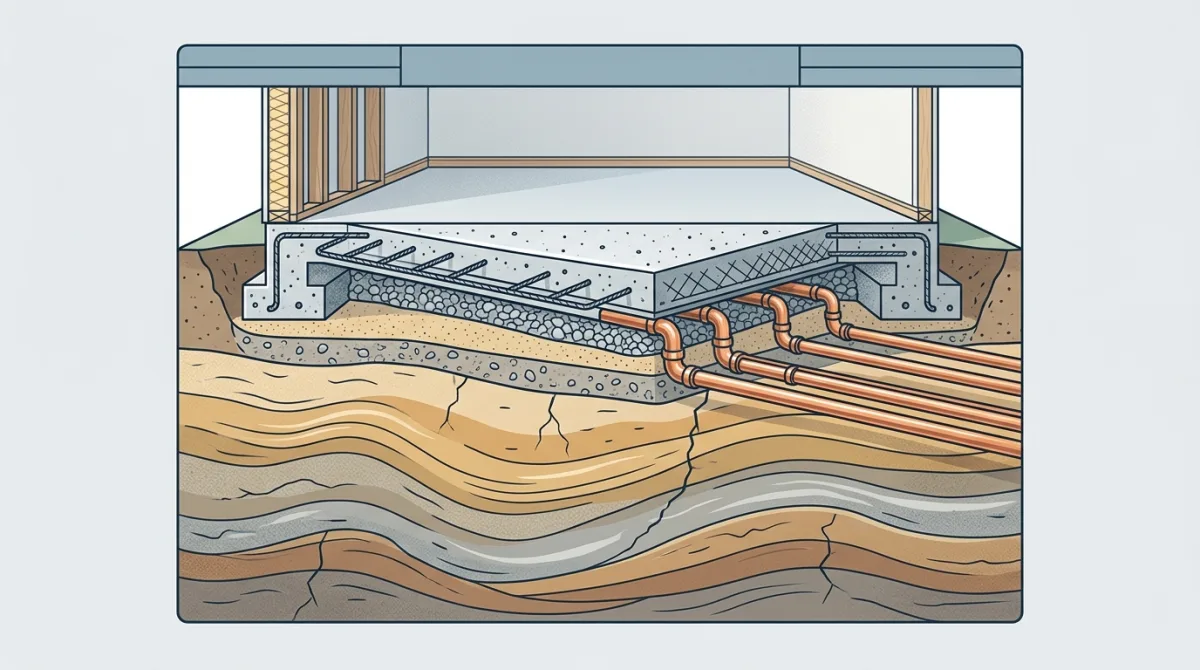
Diagram showing the relationship between slab foundations, under-slab pipes, and soil movement
Concerned About Your Fort Worth Home's Plumbing?
A pressure test can tell you whether the system is currently holding. Call to get started.